
Your Second Time in Nishi-Shinjuku, Start at Street Level: Walking Through Tokyo's Skyscrapers and Planning a Group Street Kart Day
Your Second Time in Nishi-Shinjuku, Start at Street Level: Walking Through Tokyo's Skyscrapers and Planning a Group Street Kart Day
Step out of Shinjuku Station's West Exit and you'll see one glass tower after another rising into the sky. On a first visit, almost everyone reacts the same way. You tip your head back and say "Wow, that's tall!", turn your phone sideways to fit the whole building in the shot, and then head straight for the observation deck at the Tokyo Metropolitan Government Building.
So what should you do the second time?
Walk the same streets, this time with friends, and look at a different height. Tokyo's skyscraper district is actually more interesting at ground level, and that's where I'd like to take you.
First Time, a City You Look Up At. Second Time, a City at Your Feet
The Nishi-Shinjuku skyscrapers stand along a grid of streets that runs from the west side of Shinjuku Station to Shinjuku Central Park. On a first trip, most people walk straight from the station to the Metropolitan Government Building, look down over Tokyo from the observation deck, and head back. That's a perfectly good way to see it.
A second visit is different. You already know how tall the buildings are. So this time, go looking for the plazas between the towers, the art in the lobbies, the feel of the air in the underground passages, and the skyline showing through the trees in the park. These are all things you probably walked straight past the first time.
São Paulo in Brazil also has a long line of tall buildings along Avenida Paulista. There, though, the avenue itself becomes a weekend stage. On Sundays, street musicians gather and the whole road feels like a concert venue. Nishi-Shinjuku is quieter and more orderly, and in that calm you get to hunt for each building's own "street-level design." Each city has its own rhythm, and both are fun!
You can also get from Shinjuku Station toward the Metropolitan Government Building through underground passages. The long corridor has moving walkways, and travelers pulling suitcases and office workers alike get carried west at the same pace. My guess is that most people walked above ground the first time. This time, try coming in from below.
I want to slow down a little for this part.
The ceiling underground is low, and footsteps and voices come back to you slightly muffled. You climb the stairs one step at a time, watching the back of the friend ahead of you. The moment you reach the surface, your view suddenly opens upward. The ceiling that was just above your head is gone, and walls of glass rise to fill the sky. In music terms, it's like the drop hitting after a break, and it sends a shiver down your spine. It's also fun to see how coming up just one exit over shows you the same towers from a completely different angle.
For groups, this underground route also works as a rainy-day backup. If the weather turns, you can still move west without getting wet, so it's easier to shuffle your plans.
Nishi-Shinjuku has a building that's triangular when seen from above: the Shinjuku Sumitomo Building. Plenty of people looked up at it from outside on their first trip and left it there. At its base, though, there's a plaza under a large glass roof. Even when the sun outside is harsh, the light under the roof is soft. It feels like an "indoor plaza" opening up in the middle of a canyon of buildings.
For a large group, a big covered space is a real help. Even after you've split up into smaller teams, saying "meet under the triangle building" is hard to get wrong, even for members who don't speak Japanese. Its shape stands out, so it's easy to find on a map app too.
In front of Shinjuku i-Land Tower stands a red and blue "LOVE" sculpture, the famous design by American artist Robert Indiana. Some of you may have spotted it on your first visit and thought, "Oh, I know that one!"
This time, make it your group photo spot. The letters are about as tall as a person, so it's easy to get a balanced shot no matter how many of you line up. The tilted "O" gives the picture some rhythm, so try shooting from a slight angle and not only head-on. The lines of the buildings behind it overlap with the sculpture and add depth. With a big group, have the front row crouch and the back row spread out on both sides of the letters. That alone gets everyone's face in the frame.
An American friend told me, "It's the same piece I've seen back home, but with glass towers behind it, it looks completely different." The same artwork looks different in a different city, which is exactly what a second trip is about.
Nishi-Shinjuku is also home to the SOMPO Museum of Art, known for owning one of Van Gogh's "Sunflowers." While you're walking among the towers, try stepping into the museum on a whim. The glass and steel scenery switches all at once to thick oil paint and a world of yellow.
If you're in a group, not everyone needs to go in. The art lovers can visit the museum while everyone else rests in a nearby plaza. Splitting up by interest keeps stress down, even on a trip with lots of people. Opening days and exhibitions change throughout the year, so check the museum's official information before you go.
Your first trip probably went from the station toward the towers. This time, try it in reverse. Walk into Shinjuku Central Park and turn around among the trees. The skyscrapers you were looking up at a moment ago now stand like a wall beyond the green.
Inside the park, you hear the wind moving the leaves, birdsong, and the footsteps of runners in the distance, all layered together. It's a different sound from the hum between the buildings. It's the same Nishi-Shinjuku, but the tempo feels like it has dropped a notch. Feeling that difference for yourself is what makes the reverse route fun.
The park is large, so it also makes a good rest stop for groups. If anyone is worn out from walking, sit down here for a while and talk over what's next.
At the Tokyo Metropolitan Government Building No. 1, projection mapping shows are held on the building's facade. If you saw the night view from the observation deck last time, this time try looking at the building itself from outside. The same building shows you a different face.
Keep in mind that show dates and content change depending on the season. If you plan to go, check the latest schedule on the Tokyo Metropolitan Government's official information before adding it to your plans. Sunset times, wind, and cold also vary by season, so if you're walking around Nishi-Shinjuku at night, it's a good idea to bring an extra layer.
If you're photographing the towers at night, use your phone's night mode and rest the phone lightly against a guardrail or fence to steady it and reduce blur. Just be sure you're not blocking anyone's way. When the whole group is taking a photo together, move to the edge of a plaza before lining up so you don't block the sidewalk.
Right next to Shinjuku Station's West Exit is Omoide Yokocho, a narrow alley packed with tiny restaurants and bars. Step into it after the glass towers and you're hit all at once with yakitori smoke, the smell of charcoal, and chatter from cramped counters.
Same West Exit, but a few hundred meters takes you back decades! I think that contrast is something you really appreciate on a second visit. The places are small with only a few seats, though, so a big group often can't fit into a single one. If you go, split up into twos and threes and each peek into whatever spots catch your eye. Meeting up afterward to report "this place tasted like this" is part of the fun of traveling as a group.
Logistics for Large Groups: How to Line Up Everyone's Schedule
Now for one of the biggest headaches of group travel. The more people you have, the harder it is to get everyone's schedules to match. Arrival dates, hotels, and must-see places are all different. When I travel with my Brazilian friends, it often turns into "Let's just figure it out when we get there!" Do that in Tokyo, though, and you may find the whole group can't get into experiences that need a reservation.
Start With the "Fixed" Plans
The idea is simple: lock in the things that need a reservation and have a set time first. A street kart tour is exactly this kind of experience, since you join at the date and time you booked. Weekends fill up quickly, so I recommend booking early.
Walking around Nishi-Shinjuku, on the other hand, doesn't need a reservation. You can go whenever you like. So confirm your kart booking first, then fit the walk in before or after it. Planning in this order makes it much easier to match everyone's schedules.
If you do it the other way, setting your walking plan in detail and then looking for kart availability, you may not find enough spots for everyone on the day you want. The bigger the group, the more "fixed plans first" pays off.
Check Everyone's Preparations Early in the Group Chat
There are driver's license requirements for joining a street kart tour. The documents you need depend on the type of license you hold and the country that issued it. Everyone's situation is different, so it's risky for one organizer to decide for everyone that "it's probably fine."
Once your trip plans are set, share the official driver's license page (Street Kart: About Driver's Licenses) in your group chat and have each person check their own situation. Please see the official website for details. Some documents take time to prepare, so this keeps anyone from realizing right before departure that it's too late.
A French friend told me about a trip where one person in their group forgot their documents and ended up doing something else on their own while everyone else went. Just hearing about it hurts. If you've decided to go as a whole group, check everyone's preparations as a whole group too. That's the surest way.
Meet at a Street-Level Landmark, Not Inside the Ticket Gates
Shinjuku Station has a huge number of exits. Redevelopment work is also ongoing around the West Exit, so passages and exits may look different from your last visit. Even if you agree to "meet at the West Exit ticket gates," there are several gates, and it can take a long time for everyone to find each other.
So pick a landmark above ground as your meeting place. The LOVE sculpture or the plaza at the base of the triangle building work well. They're distinctive, and anyone can find them from a single photo. If you post a photo of the meeting spot and a map pin in the group chat ahead of time, members who can't read Japanese are less likely to get lost. If someone does get lost, they can show their phone screen to station staff, smile, and say they want to go there. Even without a shared language, showing the screen often does the job.
Split Into Teams and Set Meeting Points
A big group walking together can spread across the whole sidewalk and block commuters. Nishi-Shinjuku is an office district, so on weekdays especially, plenty of people are in a hurry.
Instead, split into teams of about three to five people, each with a leader. Each team walks whatever route it likes and regroups at a meeting point you've agreed on. You can also split up by interest into a museum team, a park team, and a photo team. You don't have to stay together the whole time. As long as everyone makes it back to the same place at the end, the group trip still works.
How to Schedule Your Street Kart Day and Your Nishi-Shinjuku Day
One important point here: street kart tours don't depart from Shinjuku. Tours start from shops around Tokyo, and a guide leads you along a set route specific to each shop. You can't drive karts freely around the Nishi-Shinjuku skyscrapers.
So plan the Nishi-Shinjuku walk and the kart tour as separate activities. If you put them on the same day, one before the other, you'll need to take the train between the kart shop and Shinjuku. Travel time depends on the shop, so check a transit app and leave yourself plenty of time in between. Doing the kart tour and the walk on different days is another way to avoid wearing yourselves out.
The shops don't have parking, so go by train or other public transportation. With a large group, not everyone may fit on the same train. In that case, gather at a station a little before the shop's nearest station and go the rest of the way together. That makes it less likely anyone falls behind.
A word on group size too. The standard setup is up to six drivers with one guide. Only the Tokyo Bay shop handles large groups, and you'll ride as several separate groups. To be sure about availability and how to book for your group size, contact the official booking channels before you reserve. Bookings are taken through Facebook, LINE, and email, and contact details are on the Street Kart official website.
On the day, the tour is mainly guided in English. Whether guidance is available in other languages depends on the staff that day, so it isn't guaranteed. If someone in your group is good at English, ask them in advance to check with everyone after each explanation, something like "Did everyone get that?" That alone makes the day feel much more reassuring.
What Makes Street Kart Great
On this second trip, walking through Nishi-Shinjuku, you discovered how interesting the city is at street level. Add a street kart tour, and you get to see Tokyo from yet another height. Here's what makes Street Kart great from a group traveler's point of view.
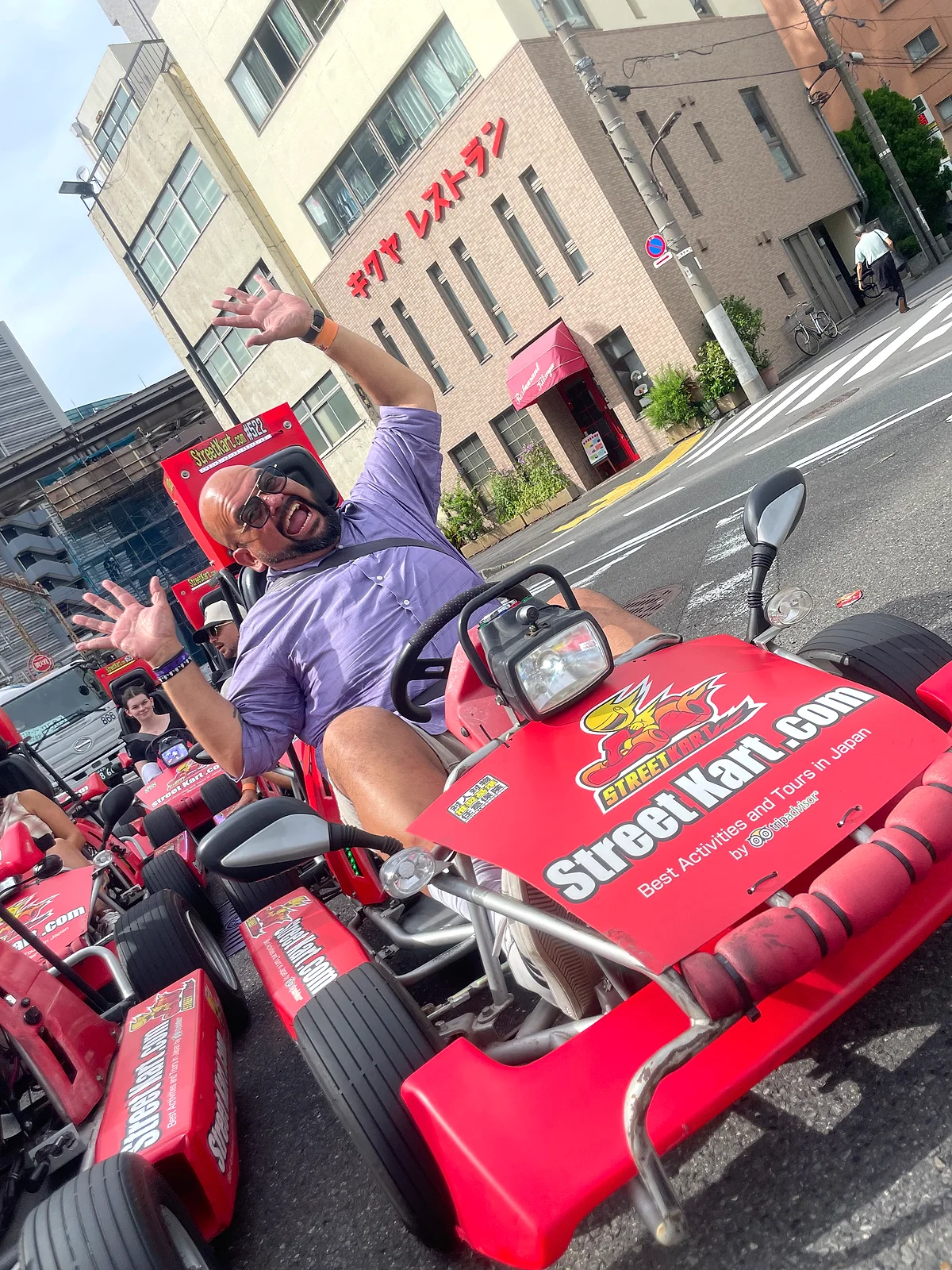
First, a guide leads the way. On Street Kart tours, a trained guide drives at the front and takes you along a set route. With a big group, it's natural to worry about someone getting lost or falling behind. On this tour, though, everyone just follows the guide. Watching the karts line up one after another in a convoy feels like the start of a small adventure!
Second, the feel of the kart itself. I want to take a little time on this too. There's no roof, and the seat sits low. Once you settle in, your eye level drops to about the waist of the people walking on the sidewalk. Stop at a light, and the tires of the car beside you look bigger than you expected. When you pull away, the wind hits you right in the face, and the sounds of the city reach your ears unfiltered. The engine's vibration travels from the seat up your back, as if your whole body is keeping the beat. If you enjoyed the "city at your feet" in Nishi-Shinjuku, I think you'll get how fresh this low viewpoint feels. You'll be looking up at the city you once looked up at, only from even lower.
Third, the numbers. As of November 2023, Street Kart had run more than 150,000 tours for more than 1.34 million customers, with an average customer rating of 4.9/5.0 across more than 20,000 reviews. That's a lot of people who have driven these karts.
Fourth, a choice of shops. Street Kart has seven shops in Tokyo, plus shops in Osaka and Okinawa, for nine locations nationwide. Among the seven Tokyo shops, though, Akihabara No. 1 and No. 2 are in almost the same place, as are the Shibuya shop and Shibuya Annex. Routes vary by area even within Tokyo, so the scenery you see depends on where you start. For example, the Tokyo Bay shop's route lists Rainbow Bridge and Tokyo Tower. Imagine looking up at the 333-meter red and white tower from that low seat. If you've already driven in Tokyo once, try picking a different area next time. Check the official website to see which routes run from which shop.
Fifth, a multilingual website. The official site is available in 22 languages. If your group comes from several countries, have everyone see whether there's a page in their own language.
Sixth, everyone shares the same scenery. On group trips, people's interests naturally split. Some want the museum, some want to relax in the park, and some want to go out at night. On a kart tour, though, each group follows its guide along a set route. It would be great if afterward you could all get excited about the same things: "Did you see that intersection?" "That building was all lit up, wasn't it?" At the end of a day spent walking separately, you'll have one shared memory of seeing the same sights together.
A word on safety as well. The karts drive on the same roads as cars. Following your guide's instructions and Japan's traffic rules comes before everything else. While driving, focus on the wheel and the road ahead, and save photos and videos for before or after the tour.
A Second Trip to Tokyo Feels New When You Change Your Eye Level
Your first time in Nishi-Shinjuku was about looking up at the sky. The second time brings moments like these: coming up from the underground passage, the plaza under the triangle building, the group photo at LOVE, the skyline seen from Central Park, and the smoke and smells of a Showa-era alley. Change your eye level and the direction you walk, and the same streets become a completely different city.
There's one more way to "change your height," and that's street kart. Tokyo as you look up at it on foot, and Tokyo from a low seat. If your whole group can experience both, your memories of the trip will be that much richer.
A big group trip depends on the planning you do at the start. First, lock in your kart booking, the "fixed plan." Prices change depending on the season and time of day, so check the official website (kart.st) for the latest information. Then confirm everyone's license situation in the group chat. Once you're ready, all that's left is to wait for the day.
So round up your crew. See Tokyo a second time, this time at everyone's eye level!
This article was originally written in Japanese and translated using AI. Some expressions may read unnaturally, and we appreciate your understanding. For the most accurate and up-to-date information, please refer to the official site at kart.st.
Street Kart is not affiliated with Nintendo or the Mario Kart series in any way. We do not provide costumes of Nintendo characters, and such costumes may not be worn during tours even if brought by participants.