
Plan Your Tokyo Group Trip Around the Time of Day: How to Get Everyone on the Same Street Kart Booking
Plan Your Tokyo Group Trip Around the Time of Day: How to Get Everyone on the Same Street Kart Booking
Is "What month should we go?" the first thing you ask in your group trip chat?
Hold that thought. The bigger your group, the less the season matters for lining up everyone's schedules. What works better is asking "What time of day do we want to be out, and which Tokyo do we want to see?" Even Shibuya looks like a different city in daylight than it does after dark. In this article, we'll work through a way for groups riding Street Kart in Tokyo to pick their travel dates starting from the time of day. Let's go!
Why do group trips come together faster when you start with "what time" instead of "what month"?
Once your group grows to five or eight people, just finding a day that works for everyone is exhausting. "Spring would be nice." "No way, fall is better." Start with the season, and everyone's preferences pull in different directions, so nothing ever gets decided.
So flip the order. The first thing you ask everyone is just this: "Do you want to see Tokyo in daylight, or Tokyo lit up at night?"
That's a choice between two or three options, so people answer fast! And when you ask, opinions often split pretty clearly. The photographers in the group pick daytime, when every detail shows up, while the night owls vote for neon and illuminations. That's totally fine.
Once you know which time of day the group wants, the next question becomes clear. If you want night views, a season when the sun sets early might give you more time slots to choose from. If you want daylight streetscapes, a season with long days leaves more room in your schedule. Your time-of-day preference naturally narrows down the season and the month.
Just changing the order moves the conversation forward fast. You're all going to see the same views together, so make "What kind of light do we want to ride in?" your opening question!
Check the official website (kart.st) for the latest information on which time slots have tours and whether you can book them.
Daylight, late afternoon, and after dark: how Tokyo changes
From here, I'll describe how Tokyo looks at different times of day, using Street Kart's Tokyo locations and the sights along their routes. Exact times shift a lot with the seasons, so instead of clock times I'll sort things by how bright the sky is.
The route from the Akihabara location passes Tokyo Station's Marunouchi building and Ginza.
The red-brick station building opened in 1914, and it's best seen in daylight. The red of the brick, the white trim around the windows, the heavy tones of the roof. As you get closer, the ornamentation of what's known as the Tatsuno-style free classical design comes into focus one detail after another. What looked like "a red building" from a distance turns into "a hundred years of history" right in front of you. Make sure you see that change with your own eyes.
Then there's the Wako clock tower at the Ginza 4-chome intersection, the Kabukiza Theatre, and the long-established department stores. I think the prestige of this shopping district, which dates back to the Meiji era, comes through best in sunlight. If anyone in your group loves design or architecture, daytime will hit the spot!
On the route from the Shibuya location, the zelkova-lined avenue of Omotesando also shines in daylight. The green leaves, the distinctive outlines of buildings by famous architects, the fashion of people walking along the street. When you ride as a group, there are moments when your friends' karts ahead of you and the cityscape fit into a single picture. I can't get enough of it!
To me, the shift from day to night is when Tokyo's look changes the most. Evening colors reflect off the glass of the buildings, and the signs light up one by one. Around the Shibuya Scramble Crossing, the rhythm of the crowds gradually switches to a nighttime tempo.
If you're moving as a group, one option is to watch the sunset from above at the Shibuya Sky observation deck in Shibuya Scramble Square before your tour, then head into the city at street level. You go right into the streets you were just looking down on. You get to experience the same Shibuya from two heights.
Keep in mind, though, that this time window shifts a lot with the seasons. Once you've picked your travel month, share with the group what the sky looks like around sunset at that time of year so everyone's on the same page.
If some of your group are pushing for night views, the Tokyo Bay (Shinkiba) and Shinagawa locations are good options, since their routes include the Rainbow Bridge and Tokyo Tower.
Take a moment here to picture it.
The 798-meter Rainbow Bridge is lit up in seven colors at night. That light shimmers as it reflects on the dark water of Tokyo Bay. Light on the bridge, light in the water. Two rainbows stacked one above the other, so it really looks like a rainbow is stretched across the bay. Then look farther out, and there's the 333-meter Tokyo Tower glowing red against the night sky. The Showa-era symbol completed in 1958 and the modern waterfront skyline, both in your view at once. Picture yourself watching those lights side by side with your friends, and the night crowd might have already won!
On the Shibuya-side routes, too, the Christmas illuminations on Omotesando are listed as a photo spot. If your group is thinking about a winter trip, picking your dates with that light-filled avenue in mind, so different from the daytime version, is another good option.
If you're going for night views, it's safest to check which time slots you can book on the official website (kart.st) first, then lock in your travel dates.
The season changes what a time slot is actually like
Once you've settled on a time of day, the season comes next. This is the important part: the same time of day can feel completely different depending on the season.
Take a group that picked daytime. In seasons with long days, you've got more time to work with. But midsummer afternoons in Tokyo get seriously hot. Keep in mind that you'll be driving with the sun beating down and heat coming off the pavement. If anyone in your group struggles with heat, it's worth looking at the available time slots to see whether you can shift toward the part of the day when the sun is less intense, even within "daytime."
Now take a group that picked night views. In seasons when the sun sets early, you may have more time slots with night scenery to choose from. On the other hand, the air is colder, and you'll be in the wind while you drive. Talk with your group about how you'll stay warm before you head out.
How rain is handled and what happens to tours in bad weather are also things you'll wonder about depending on the season. The official website explains its weather policy, so read through it before you pick your travel dates and you'll avoid scrambling on the day.
To sum up: if you narrow things down in the order "time of day season specific date," it's easier to land on something everyone's happy with. Think of it as sorting out everyone's preferences and tolerances by combining time of day with season.
Planning steps that matter more the bigger your group
Now let's get into planning steps specific to groups. In a big group, everyone tends to wait for someone else to decide. So set roles and an order of steps up front.
Weekends book up fast, so we recommend booking early. The bigger the group, the more likely it is that the only days everyone's free are weekends. That's exactly why the person handling the booking should be ready to act the same day you settle on your time slot and date options.
Rather than waiting until everyone's wishes line up perfectly, it's more realistic to decide on a "first-choice time slot" and a "second-choice time slot" in advance. If your first choice is full, go straight to your second. That saves you from dozens more messages going back and forth in the chat.
Bookings are accepted through Facebook, LINE, and email (booking@streetkart.com). When you contact them to book, you'll need the country that issued each driver's license, the number of drivers, your preferred date and time, and your preferred location. Things go more smoothly if you gather everyone's information with the person handling the booking.
The worst thing that can happen on a group trip is someone finding out on the day that they can't drive with their license. You really want to avoid this! Which licenses are accepted and what you need to bring varies from person to person.
Before you set dates, have everyone in the group check the driver's license page on the official website (https://kart.st/en/drivers-license/). Some of the required paperwork can take time, so check early and use it as one of the factors when deciding when to travel. See the official website for details.
Don't assume on your own whether your whole group can ride together or whether everyone can be in the same time slot. According to the information provided, the standard setup is up to six drivers plus one guide per group, and larger groups are only handled at the Tokyo Bay location, where they're split into multiple groups. Check the official website for details, or get in touch early.
The karts are single-seaters, so no passengers are allowed. Everyone who rides drives their own kart. If some people in your group will ride while others wait nearby during the tour, sort that out ahead of time too.
Cancellations are listed as free up to seven days before. But with big groups, one or two people's plans can change at the last minute. Check the latest terms on the official website, and decide within your group ahead of time how many days before the tour you'll confirm the final headcount.
The locations don't have parking. Take public transportation to get there.
In a group, if just one person is late, everyone ends up waiting. If you decide to "meet at the nearest station and head over together," you'll avoid people getting lost or running late. For example, the Shinagawa location is a 3-minute walk from Keikyu Kita-Shinagawa Station, the Tokyo Bay location is an 8-minute walk from Shinkiba Station, and the Shibuya and Shibuya Annex locations are a 5-minute walk from Shinsen Station.
Plan before and after your tour around your chosen time of day
Once you've picked a time of day, what to do before and after the tour falls into place. The places below aren't on the tour routes. They're spots near each location that you can visit before or after your ride.
Toyosu Market is about 10 minutes by car from the Tokyo Bay (Shinkiba) location. If most of your group are morning people, you can start with a sushi or seafood breakfast at Toyosu, then head to a daytime tour. After the tour, you could head to DiverCity Tokyo Plaza or Aqua City Odaiba in Odaiba for shopping or lunch.
Shinagawa Shrine is about a 5-minute walk from the Shinagawa location. It's a shrine with a Fujizuka (a miniature Mount Fuji), and climbing its stone steps together before the tour is a nice way to get the group in the same mood. After the tour, walk about 20 minutes to Tennozu Isle. Art galleries and cafés line the canal, which makes it perfect for winding down after the ride and looking back through your photos.
Around the Akihabara location, you can stroll through the electric town at night after your tour. Grab some ramen or a set meal under the glowing signs before heading back to your hotel. Your night-owl members will love it! Stopping by Kanda Myojin Shrine, about a 10-minute walk away, before the tour is another good choice.
Near the Shibuya and Shibuya Annex locations, there's Dogenzaka Ramen Yokocho and Shibuya Niku Yokocho. After a night tour, sit down together and talk about everything you saw that day.
What makes Street Kart work for groups
We've talked a lot about time of day. To wrap up, here are the points to keep in mind when choosing Street Kart for a group trip.
First, every tour is led by a trained guide. Each tour follows the set course for its location.
Second, Tokyo has several locations, and each route shows you a different set of sights. Seven of the nine locations nationwide are in Tokyo. Akihabara 1 and 2 are in almost the same spot, and so are Shibuya and Shibuya Annex. Even so, the routes feel clearly different: Tokyo Bay and Shinagawa for the waterfront bridge and tower, Akihabara for the red-brick station and Ginza, and Shibuya for the Scramble Crossing and Omotesando. Use these directly as your options when you discuss which sights you want to see at which time of day.
Third, language. On the day of the tour, guidance is generally in English. Guidance in Japanese or other languages depends on the staff that day and isn't guaranteed, so ask ahead of time if it matters to you. The website is available in 22 languages. Why not start your pre-booking research by having each person open the site in their own language?
Fourth, the track record. As of November 2023, they report over 150,000 tours run, over 1.34 million customers, over 20,000 reviews, and an average rating of 4.9 out of 5.
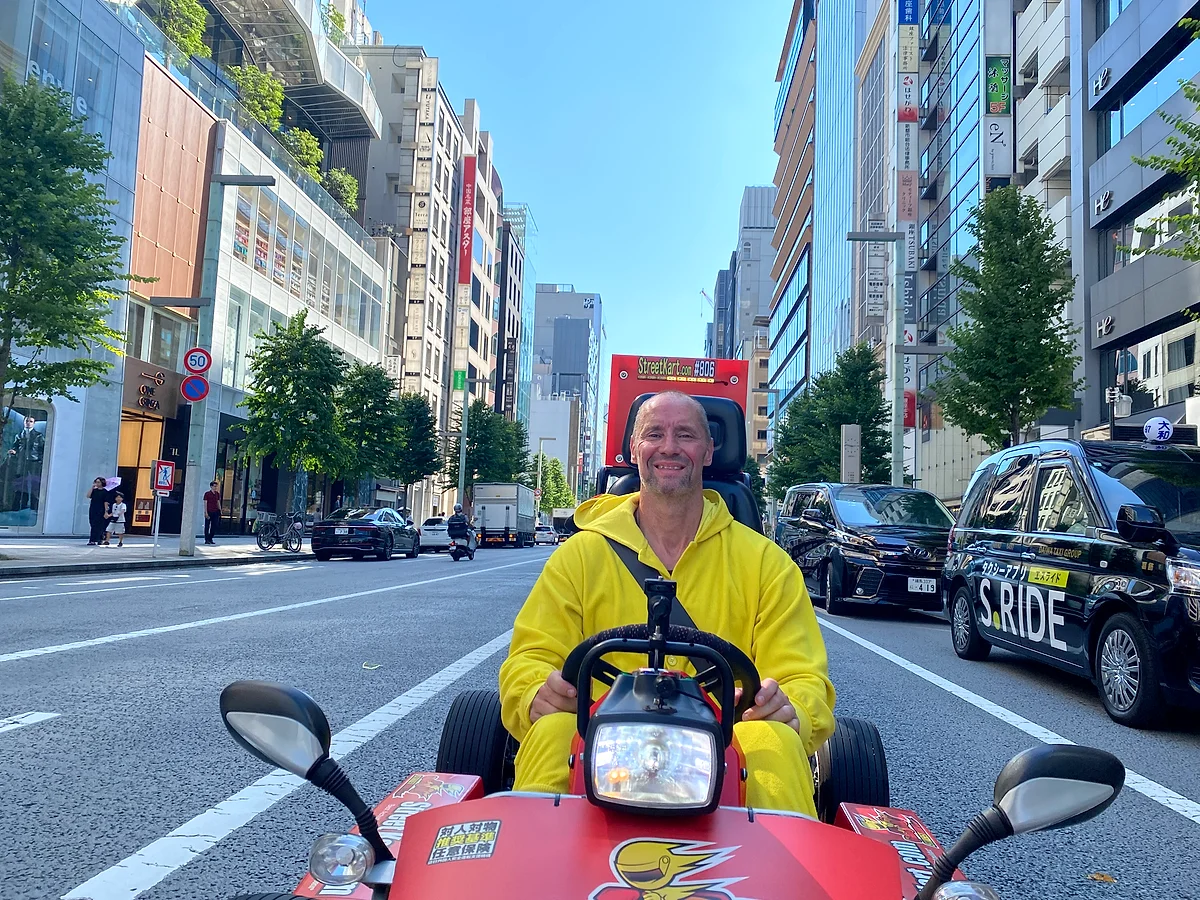
And finally, the feeling of the ride itself. The height of the buildings and the width of the intersections come at you on a scale that's different from walking or looking out a car window. The wind, the sounds of the city, the crowds surging forward the moment the light changes. Taking all of that in at the same moment as your friends is something that will come rushing back every time you look through your trip photos.
Start by asking your group which Tokyo light they want to see
When you're deciding when to travel, before you even open a calendar, try asking your group chat just one question:
"Do you want to see Tokyo in daylight, or Tokyo lit up at night?"
Once the answers are in, narrow down the season, check licenses, set your first- and second-choice time slots, and have the booking person take it from there. Follow this order and the conversation won't get lost, even with a big group.
See the official website (kart.st) for details. Book through Facebook, LINE, or email (booking@streetkart.com). Weekends fill up fast, so we recommend reaching out early, as soon as your dates are taking shape.
It's the same Tokyo, but change the time of day and the views are completely different. Red brick by day, or the rainbow bridge by night? Start by deciding together which light you want to ride in!
This article was originally written in Japanese and translated using AI. Some expressions may read unnaturally, and we appreciate your understanding. For the most accurate and up-to-date information, please refer to the official site at kart.st.
Street Kart is not affiliated with Nintendo or the Mario Kart series in any way. We do not provide costumes of Nintendo characters, and such costumes may not be worn during tours even if brought by participants.