
Asakusa, Tokyo Changes With the Hour: How Groups Can Pair Morning, Afternoon, and Evening Views With a Kart Tour
Asakusa, Tokyo Changes With the Hour: How Groups Can Pair Morning, Afternoon, and Evening Views With a Kart Tour
Picture yourself at Kaminarimon before the crowds arrive. The huge lantern catches the morning light and sways just a little. You can barely hear a thing.
Now come back to the same spot in the early afternoon. Voices in all kinds of languages reach you from every side, and you probably won't be able to help smiling.
Then, as the sun goes down, the surface of the Sumida River changes color and the old-town atmosphere slowly quiets down.
Asakusa looks different every time the clock hand moves. So if you're going with friends, deciding when to go settles most of what your trip will be like!
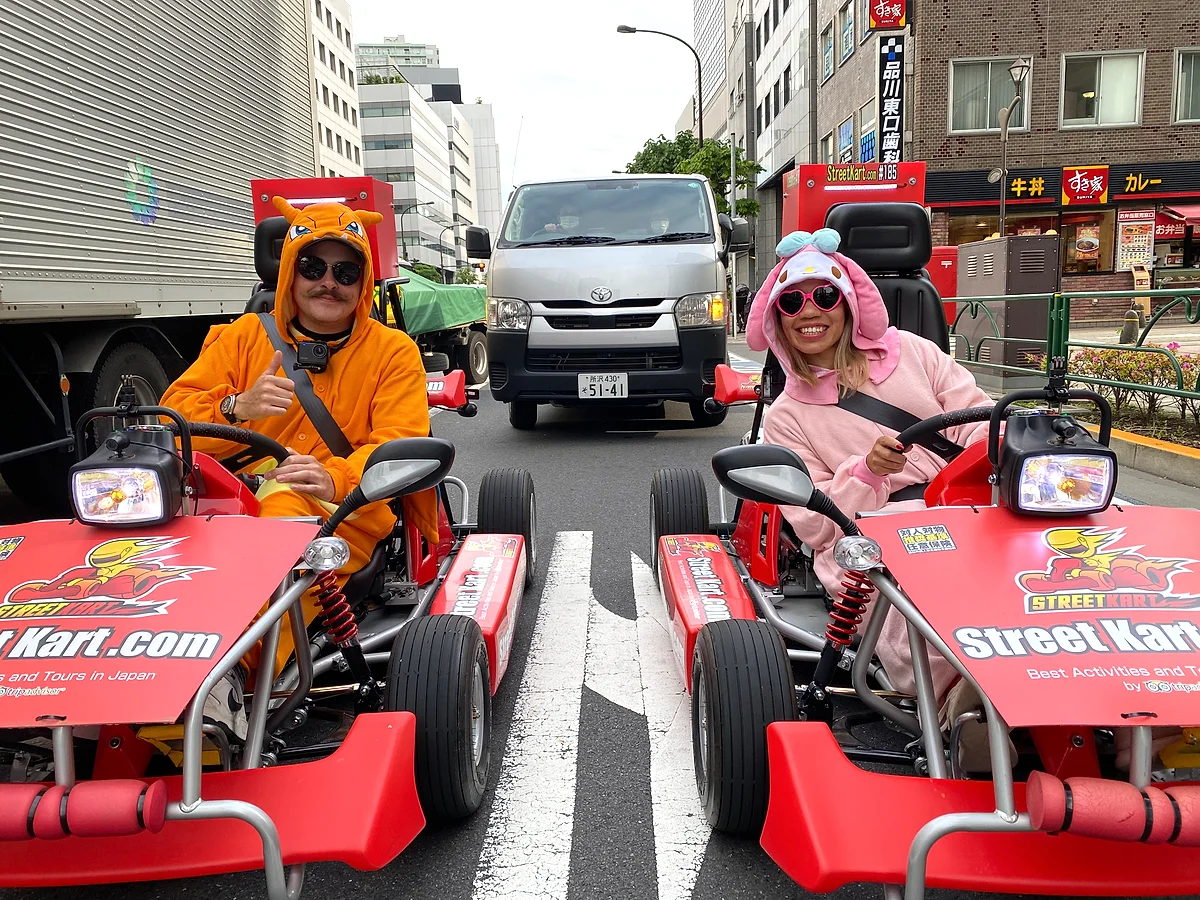
In this article, we'll look at what Asakusa looks like at each time of day and how to plan a day that holds together even with a big group. We'll also look at how it fits with a Street Kart tour.
Why Does the Same Kaminarimon Look So Different at Different Times?
Asakusa is one of the places where you can still get a real feel for Tokyo's shitamachi, the city's traditional old downtown. There's Nakamise, the shopping street leading up to Senso-ji Temple, tiled roofs and paper lanterns, and the Sumida River just a short walk away. Across the river stands the silhouette of Tokyo Skytree, so old Tokyo and new Tokyo fit together in a single view.
The main sights are in the same place morning and night, yet they look completely different. The reason is simple: the amount of light and the number of people change a lot over the course of a day.
Think of it in musical terms. It's like playing the same melody as a bossa nova or as a samba. The song doesn't change, but the mood it gives you does. Morning in Asakusa is a slow bossa nova, afternoon is a samba with the percussion turned all the way up, and evening slows things down again into a ballad. You get three songs in one day. How fun is that!
There's one important point to make first: the season. Sunrise and sunset times shift a lot through the year, so nobody can say for sure what time you'll catch the sunset. At the same hour, the sky can be completely different in summer and in winter. On the day of your trip, check the sunset time in a weather app and plan around it. If you keep your plans that flexible, everyone in the group can enjoy the day without pushing too hard.
Asakusa in the Morning: A Quiet Temple Approach Saved for the Early Risers
When the crowds are thin, Asakusa is truly quiet.
Nakamise's shutters are still down, and the only sound is a broom sweeping the street. A faint smell of incense hangs in front of the main hall, and the stone paving is still a little cool. The whole neighborhood seems to be halfway through a deep breath. Stand in the middle of the approach at this hour and your own footsteps sound strangely loud. It's a little embarrassing, and kind of nice.
If anyone in your group loves photography, don't miss this time of day! With no one in the frame, the red of Kaminarimon, the black lettering on the lantern, and the dark gray of the roof tiles come straight through. From a design point of view, that's an incredibly strong palette made of just red, black, and gray.
That said, not everyone in a group will be able to get up early. Here's a planning tip: don't try to go all together! Let the morning people head out first and have everyone else join later. That way no one has to push themselves. If you pick an obvious landmark like Kaminarimon as the meeting point, even friends visiting Tokyo for the first time are unlikely to get lost.
Every destination has its own kind of pleasant morning. In Asakusa's temple district, the air is clear and you naturally stand up a little straighter. If you'd like to start your day quietly, I think this is the perfect time.
Asakusa in the Afternoon: Decide as a Group Whether to Enjoy the Crowds or Avoid Them
Asakusa in the afternoon is bursting with energy!
The approach is packed, and you hear English, Spanish, French, and all kinds of Asian languages one after another. The sweet smell of baked snacks drifts by on the breeze, and before you know it, everyone has stopped walking. People from all over the world are looking at the same things and laughing the same way. Just watching it puts you in a good mood too.
For a large group, though, the crowds can be a bit of a challenge. Get swept up in the flow of people and your group splits up in no time. It's easy to think you can just message each other, but in a packed place people often don't notice replies.
So before you set out, agree on a rule: "If we get separated, come back here." One place and one time. That's all it takes for everyone to stay calm if someone gets lost. It's the same idea as staff at a crowded event venue agreeing on a meeting point in advance.
This is also a time of day when big groups tend to end up waiting for a table. Rather than trying to fit everyone into one restaurant, it often works better to split into twos and threes, eat whatever you like, and meet up at the agreed time. Even if you can't read the menu, you have the camera feature on a translation app. Point with a smile, and the staff will usually understand!
Asakusa From Dusk Into Night: When the Lights Come On, the Old Town Slows Its Rhythm
As the sun goes down, Asakusa suddenly turns dramatic.
Long streaks of orange light stretch across the Sumida River. The silhouette of Tokyo Skytree slowly melts into the sky. As the daytime bustle fades, the lanterns take over as the main attraction. The air during those few dozen minutes of change is truly beautiful. On stone paving still warm from the day, the lights start to stand out one by one. Watch that moment side by side with your friends.
The hours and dates when buildings are lit up can change, so no one can promise exactly how things will look on a given day. Go ready to accept whatever the sky and the lights bring, and you may end up with a shot you never expected.
There are a few tricks to night photography. In the dark, the shutter speed gets slower, so brace your elbow against a railing or a wall to steady yourself and cut down on blur. For group photos, have people face the light rather than stand with it behind them, and their faces will come out brighter. Not pointing a flash at other people is good manners in any country.
You don't need to cover morning, afternoon, and evening all in one day. If you have enough days, you could do "morning Asakusa today" and "evening Asakusa another day." See the same Kaminarimon twice and get a different view both times. I think that's the best part of choosing Asakusa by the time of day.
Three Ideas for Planning a Day That Holds Together Even When Everyone's Schedule Is Different
The bigger the group, the harder it is to fit everyone into one plan. People wake up at different times, want to see different places, and have different energy levels. That's exactly why it helps to split the plan into "fixed parts" and "flexible parts."
First, lock in anything with a set time. A Street Kart tour, for example, runs at a fixed time, so book that first and fit your Asakusa time around it. Asakusa shows you a different side whenever you go, so letting it be the flexible part takes nothing away from the fun. Weekends in particular tend to fill up, so once your group's dates are settled, it's best to book early.
Second, leave room for travel. Street Kart shops don't have parking, so take public transportation instead of driving. When a large group rides the train, even getting everyone through the ticket gates takes longer than you'd think. Check your route for the day in a transit app, and plan to arrive a little early instead of right at your booking time. You'll feel much more relaxed.
Third, make sure everyone is on the same page before you head out. This part deserves care. To drive a kart, you need a valid driver's license that allows you to drive a car, and you must be 18 or older. Which licenses are accepted depends on the issuing country and the type of license. On the day, you need the original physical license and your passport. Digital licenses are not accepted. If you don't have the required documents, you can't take part, and there are no refunds. Each member should check in advance on the official driver's license page whether their license qualifies. One person being unable to drive once you're there is the one thing you really want to avoid on a group trip.
One more thing: tour guidance on the day is basically given in English. Guidance in Japanese or other languages depends on the staff working that day and isn't guaranteed. If someone in your group is comfortable in English, having them relay the explanations helps keep everyone in step. Also, a standard group is made up of up to 6 drivers and 1 guide. Larger groups can only be handled at the Tokyo Bay shop, where you'll ride split into multiple groups. If your group is big, contacting them before booking will make things go faster.
How to Line Up Your Asakusa Time With a Kart Tour
First, the important part: plan your Asakusa walk as a separate leg before or after the tour, and check the actual driving routes on the official website (kart.st). Tours follow a set route for each shop, led by a guide.
With that in mind, there are lots of ways to put your day together.
You could walk around quiet morning Asakusa and then join a tour from one of the Akihabara shops. The day's tempo builds gradually, moving from the calm scenery of the old downtown to the busy streets of central Tokyo.
Or you could do it the other way around: enjoy the tour first, then head to Asakusa in the evening. You can let the post-ride excitement wind down slowly with the sunset over the Sumida River.
Like a DJ building a set list, decide where to put the high point of your day. Talking that over with your friends is already part of the trip!
Please check tour times and the latest information on the official Street Kart website.
What Makes Street Kart Great: Six Things You Notice When You Ride as a Group
First, a guide leads the way. On every Street Kart tour, a trained guide drives at the front, keeping an eye on the route and on safety. There's also a safety briefing before you set off. All you have to do is follow the guide in front, which leaves everyone free to focus on driving and on the view. That's what I like about it.
Second, the range of scenery along the routes. Some tours from the Akihabara shops include the red-brick Marunouchi Building of Tokyo Station, which opened in 1914 (Taisho 3) and whose restoration was completed in 2012, as well as Ginza, home of the Wako clock tower. The sign-covered Akihabara Electric Town is another. Nearby, you'll also find Kanda Myojin, known as the guardian shrine of old Edo, and Ochanomizu, home to Holy Resurrection Cathedral (Nikolai-do). It's a completely different Tokyo from the tiles and lanterns you saw in Asakusa that morning.
Third, everyone gets their own kart. The karts are designed for a single rider, and passengers aren't allowed. That means every member of the group takes their own wheel. Even on the same route, everyone's impressions will be a little different once you finish: "Did you see that building?" "That intersection was crazy, right?!" I think comparing those different takes is the best part of riding as a group.
Fourth, the track record. As of November 2023, across all shops combined, Street Kart had run more than 150,000 tours, served more than 1.34 million customers, and collected more than 20,000 reviews, with an average rating of 4.9 out of 5.0. When a first-timer in your group asks what it's like, it's reassuring to be able to back up your answer with these numbers.
Fifth, the choice of shops. Street Kart has 9 shops nationwide, 7 of them in Tokyo. Keep in mind, though, that Akihabara Shop 1 and Shop 2 are in almost the same place, and so are the Shibuya shop and Shibuya Annex. They're not spread across seven different areas of Tokyo. If you're pairing your tour with Asakusa, choosing one of the Akihabara shops makes it easier to picture how the day will flow. As mentioned earlier, though, keep in mind that groups of 7 or more are handled at the Tokyo Bay shop.
Sixth, the website is available in 22 languages. However, tour guidance on the day is basically in English. The website's languages and the language of the guidance on the day are separate matters, so don't mix them up. If there's anything in the explanation you don't understand, don't hesitate to ask your guide again. A question asked with a smile can even be the start of a great conversation on your trip!
Which Asakusa Will You Capture Together?
The calm of the morning. The energy of the afternoon. The lights of the evening.
Asakusa has a completely different rhythm depending on the time you choose. And on a group trip, not everyone has to be in the same place at the same time. The early risers go to the morning approach. The laid-back crew joins in the afternoon. Everyone comes together for the kart tour. Just splitting your plans into "fixed parts" and "parts you go with the flow on" makes a big group trip much easier to manage.
Street Kart accepts bookings via Facebook, LINE, and email. You can find each contact option on the official Street Kart website. Weekends tend to fill up, so once your group's dates start to come together, move early.
Your original driver's license and your passport. Your route for the day. A meeting place in case you get separated.
Make sure everyone has these three things sorted before you set off. After that, all that's left is to look up at the Kaminarimon lantern and take your own wheel.
So, which Asakusa will you start with? Decide together!
This article was originally written in Japanese and translated using AI. Some expressions may read unnaturally, and we appreciate your understanding. For the most accurate and up-to-date information, please refer to the official site at kart.st.
Street Kart is not affiliated with Nintendo or the Mario Kart series in any way. We do not provide costumes of Nintendo characters, and such costumes may not be worn during tours even if brought by participants.